Never forget that the universe is a single living organism possessed of one substance and one soul, holding all things suspended in a single consciousness and creating all things with a single purpose that they might work together spinning and weaving and knotting whatever comes to pass.
Marcus Aurelius
This is an interesting take on the nature of reality, because I wouldn’t expect to hear it from someone with Aurelius’s background. I guess I hadn’t put much thought into the idea of an afterlife from a Stoic point of view, because the philosophy predominantly addresses how to live in and enjoy the present.
What Aurelius is expressing is known as Pantheism, “the belief that God consists of everyone and everything. For example, a tree is God, a mountain is God, the universe is God, all people are God.” 1 It reminds me of the popular quote about how we are all the universe experiencing itself.
This is an artist’s impression of a black hole drifting through the Milky Way galaxy. 2
I’m also reminded of the fact that people are made up of smaller communities of creatures and systems that developed into humans over time, and then I think about the universe as a whole and wonder if the universe is some larger being, or part of a larger being. What if we’re actually just part of a digestive tract and black holes are how the energy we produce is passed on to the other systems of the larger organism? What if our universe is a marble in a sack of marbles? You never know.
But in terms of pantheism and how it was understood, that we are all manifestations of the divine or that some divine essence undergirds and flows through all existence, the idea seems to be common to some Buddhists, Hindus, and some forms of Christianity, like Unity, Christian Science, and Scientology. There is also some overlap between Stoicisms understanding of the soul returning to the Cosmic Fire and being reforged as a new soul and the Buddhist idea of the soul reaching Nirvana, escaping the cycle of rebirth and permanently reuniting with the divine essence. Early Christians believed in reincarnation as well, and the Christian idea was probably closer to the Stoic conception because in Buddhist reincarnation there is an expectation that souls retain something from previous lives, even if it’s just karma.
The concept of pantheism also has parallels with mainstream beliefs about Jesus being an expression of God in the physical realm. And of course, there’s the idea that God blew his breathe into humans to give us sentience, but humans carrying a divine spark is a bit different from the idea that all things are God.
Still, it’s interesting to see how ideas about divinity and existence develop over time, often overlapping, and have common themes between the past and present.
A symbol of creation and destruction and the struggle to overcome ego through #spiritual#contemplation, the Shiva Nataraja, or Dancing Shiva is one of my favorite religious symbols. This explanation of the symbol by Aldous Huxley isn’t very thorough, but it’s clear and easy to understand.
I think what I appreciate so much about it is that it’s so comprehensive that you can meditate on the meaning of all reality just through the symbolism in this image. Birth, death, the infinite vastness of time and space, the insignificance of our place in it all, and the need to struggle to be better people anyway.
I wonder, were it not for the Jewish restrictions on creating images of the divine (which was more literally expressed in Islam), would we have a richer and more complex tradition of religious symbolism in the West. Something as complex as this image to describe the Abrahamic God or the Trinity and the Christian worldview.
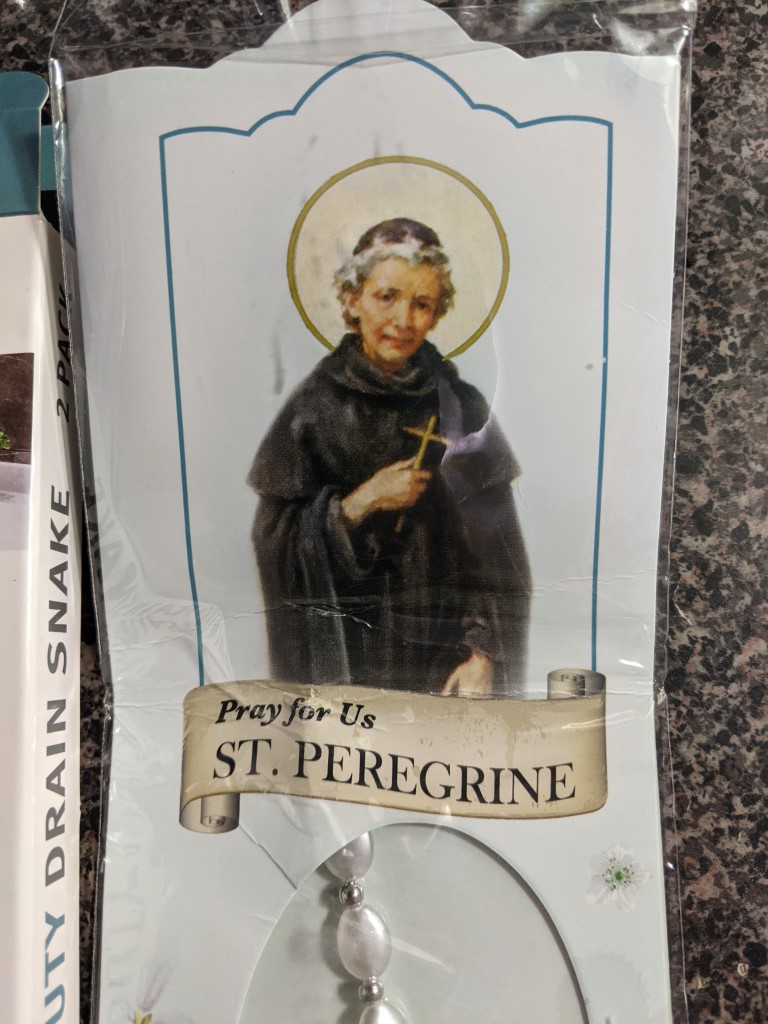
“Pray for Us St. Peregrine” prayer beads that were hidden in a heavy-duty drain snake box purchased at Walmart.
A few weeks ago, I picked up a drain snake from Walmart. We prefer using them to dumping harsh chemicals down the drain. We’re trying to be more environmentally conscious, and we figure it’s probably better for our health and the health of our pets than Drano fumes.
Yesterday, I finally opened the box. I had some trouble getting the cardboard slide that the snakes were attached to out because they were hung up on something. Turns out it was a set of Catholic prayer beads that had been tucked into the back of the box.
A close-up of the Pray for Us St. Peregrine prayer beads.
I imagine some enterprising individual went around Walmart and stashed these prayer beads in random products to get them into people’s homes and hands. It’s a clever idea. They reach people that otherwise would never think to take one when offered. It was thoughtful, and their heart was in the right place.
However, it’s also a little annoying, because now I have the burden of trying to figure out what to do with them in a way that’s respectful. We’re not Catholic, but I don’t want to dump them in the trash either. I figure I’ll check with coworkers and neighbors and if that’s a bust, then I’ll drop them off at the nearest Catholic Church.
But, maybe that’s part of the plan too! To create opportunities for dialogue between non-Catholics and Catholics.
I’m really late to the party, the first book in the series having been published in 1997 when I was still in high school, but I’ve been borrowing the audiobooks of the Harry Potter series from the New York Public Library and I’m really enjoying them. I think I would have loved them as a kid but I was going through a phase where I was really into church dogma and the Harry Potter series was said to be evil and demonic because it supposedly encouraged children to engage in witchcraft.
Putting aside the question of whether witchcraft is real or not, I can see how the Harry Potter series was threatening to organized religion. It provides an alternative fantasy world that presents a set of moral values in a compelling way and, even when it doesn’t conflict with the church’s vision of morality, it competes for attention. I’d guess Harry Potter is probably winning that contest too, given the success of the books and movies and the ever dwindling levels of church attendance.
I wonder how much of the church’s problems these days comes from an insistence on biblical literalism? It’s been a while since I studied the Bible, either academically or religiously, but I do recall that many of the stories have parallels in other nearby cultures. For example, the story of Moses and the flood is essentially the same story as the Epic of Gilgamesh with modifications to fit the local culture. That alone should tell us that stories in the Bible were meant to be educational rather than literal history. It makes more sense to tell someone that they should be looking at a story in the Bible for moral guidance than to tell them to take it as literal word from God history and expect that story’s relevance to endure over any length of time.
And maybe that’s why Harry Potter does so well. We know it’s not word from God and we don’t face the choice of having to either swallow it whole or throw it out. We can instead appreciate it and think about it and try to apply it to our lives if it makes sense in relation to what we understand to be good and bad.
All of these thoughts congealed in my head as I started to realize how the Weasleys were being presented in the books. They may not have fancy clothes and they may not always get along but they value what’s important in life: their kids, each other, friendship, and (in Molly and Arthur’s case) their kids’ education. In addition, even though they’re struggling they essentially adopt Harry into the family, so there’s a lot of love and charity being displayed there. They share even when there’s not much to give. They’re loyal. They do things together. It’s sort of a model for the proper behavior of a family, especially when it comes in such stark contrast to how Harry is treated by his aunt and uncle. The fact that both Harry and Hermione later marry into the Weasley family reinforces the idea that they represent an ideal family.
I’m only partway through the fourth book and I wasn’t really thinking about the story too deeply until now, but there’s really more in these books than shallow entertainment. I’m not really surprised. I don’t think they would have done so well if they didn’t have something substantive to offer readers.
A common refrain on message boards and in comment sections on the Internet is that Jews, Christians and most especially Muslims do not worship the same God. Is there any merit to this statement? All three religions are part of the Abrahamic tradition and find their roots in the ancient Hebrew faith. Modern Judaism developed after the fall of the Second Temple in 72 CE. Christianity as we know it today probably began with Paul’s teachings and solidified with the Council of Nicea in 325 CE, though it began as a Jewish movement around 30 CE. Islam, the newest (or oldest, depending on your religious perspective) of the three religions dates its beginning to approximately 610 CE and both draws and builds on Jewish and Christian religious traditions. All three religions share stories and in some cases texts. All three claim to be worshipping the God of the Patriarchs. All three also clearly conceive of God in different ways. Do we judge whether they worship the same God based on their own claims, or on their understandings of the nature of God?
A related video on the topic from YouTube:
In “The Perspective of at-Tawhid” (1983), Muhammad ‘Abdul Haq argues that there is a distinct difference between the monotheisms practiced by Jews, Christians, and Muslims. Writing from an Islamic perspective, the foundation of ‘Abdul Haq’s argument is the differing conceptions that Jews, Christians, and Muslims have about the unity (at-Tawhid) of God. He is critical of both Jews and Christians and believes that, because of their diverging religious traditions, they have an imperfect understanding of monotheism.
‘Abdul Haq argues that, while Islam places ultimate importance on the concept of the divine unity of God, both Judaism and Christianity are based on divine manifestation in history. He links the idea of monotheism in Judaism with the concept of ‘chosenness’ and the pact made at Mount Sinai. Because of this, he feels that it is impossible to disassociate the God of Judaism from the Jewish people as an ethnic group, making the conception of the Jewish God contingent on a historical event. Regarding Christianity, ‘Abdul Haq points out that everything revolves around the person of Jesus Christ and the events of his life, which also roots Christianity firmly into history.
The author believes Judaism and Christianity’s entrance into history is important because it differentiates them from Islam, which he claims has an absolute truth versus the formers’ relative truth. In other words, Islam sees God as being utterly transcendent and beyond our conception while both Judaism and Christianity place God in history, thereby restricting his essence. One could also argue that God sending Gabriel to reveal the Quran to Muhammad was an intervention in history. However, the difference is that in Judaism and Christianity, God Himself appears in history, while in Islam He works through an intermediary, Gabriel. The result is the same: an intervention in history, but the method is what sets Islam apart. Muslims see God as being beyond history, because entering history would necessarily restrict or limit his essence.[1]
He also states that Judaism monopolizes and nationalizes monotheism and prophecy.[2] This is not actually, true, however. While it was perhaps not always the case, modern Judaism does have a conception of God as being universal. This is not a new development, either. The Noahide Laws in Genesis, which are seven rules that apply to non-Jews, provide redemption for those who follow them. Essentially, it is a path to participation in monotheism without being Jewish. There is, of course, still a difference between inclusion in the covenant community and being a part of the Noahide community, but this still contradicts ‘Abdul Haq’s point.
Christanity, like Islam, has a universal message, but the author is still critical of the concept of the Trinity, which he bluntly states is not monotheism, regardless of how the explanation is framed.[3] Returning to the idea of God’s essence, he writes that “Judaism and Christianity have failed to evaluate the true worth of Divine Unity, the incommensurable nature of which signifies that there is no common measure between the finite and the Infinite.”[4] Breaking God down into parts is counter to Islam’s idea of God’s unity, which cannot be subdivided or contained.
Another way to look at the similarities and differences between the Abrahamic religions’ conceptions of God is by comparing their revelatory and mission structures. Martin Jaffee does this well in his article, “One God, One Revelation, One People: On the Symbolic Structure of Elective Monotheism” (2001). Jaffee engages with the symbolic structures of the Abrahamic religions to show that they are constructed in a way that brings them into almost inevitable conflict. He believes that their structural similarities, along with the decline in polytheism as a viable competing model of piety, explains what Jaffee calls their obsessive self-definition “over against” each other.[5]
Essentially, Jaffee looks at how the Abrahamic communities see themselves in relation to God and how they see their mission in history. For Israel, the “divine self-disclosure” comes in the form of human language via the Torah, a scriptural set of commandments passed down to man.[6] In Christianity, the divine self-disclosure comes in the form of Jesus’ historical life. This is distinct from Judaism, because it is not revelation transmitted in the form of human language. In Islam, the form of divine self-disclosure is textual, like it was in Judaism. The position that Islam takes on the previous two divine self-disclosures is that people altered the original texts and changed their meanings, which is what necessitated the third divine self-disclosure. Islam sees the Quran as a corrective that is meant to reestablish monotheism as universal and inviolable. This does not imply that Islam sees the Jewish and Christian views of God as the same or valid, however.
Writing in response to Jaffee, Yehezkel Landau attempts to bridge that gap in “God as Multiple Covenanter: Toward a Jewish Theology of Abrahamic Partnerships” (2015), an article that presents Christianity and Islam as legitimate, additional covenants between man and God. Landau asks, “[C]an monotheism be pluralistic, …that is, if God is One, how can different understandings of that Oneness be valid?”[7] Landau is attempting to present the God of the Torah as the same God worshipped in Christianity and Islam. He does this by finding a precedent in the Torah and then explains how Christianity and Islam fit into that existing pattern.
When people think of God’s covenant with Israel, the first thing that comes to mind is probably the covenant with Abram / Abraham that includes circumcision and a promise to make Abraham’s descendants plentiful. Landau argues instead that there are many covenants in the Torah that apply not only to Jews, but to all nations, starting with the covenant of the Sabbath. He notes that in Isaiah 56:1-7, Sabbath observance also applies to any stranger or foreigner that chooses to “join himself to the Eternal.”[8] The next covenant Landau reviews is the Noahide Covenant, which binds God, all human beings, and other living things on Earth. Lastly, Landau discusses the significance of the Abrahamic Covenant and Abraham’s role as the progenitor of both Israel and the Arabs, linking God’s covenant to Islam. The idea is, perhaps, to imply that part of God’s promise to Abraham is being carried out through the descendants of his son, Ishmael, as well as through Jacob / Israel.[9]
Landau casually dismisses non-Orthodox positions on religious pluralism, which is disappointing in a paper written to supposedly present a Jewish viewpoint. He simply states that they are more likely to be open to religious pluralism since they don’t follow halakha as strictly. It would have been more interesting and informative to see what the major Jewish denominational positions are, rather than having them dismissed out of hand, especially since most Jews are not Orthodox. In Landau’s defense, it is possible he believes his primary audience will be those who are not yet convinced and by his reasoning those people would tend to be Orthodox.
Another problem in Landau’s article is that he draws on the work of an Orthodox Rabbi named Irving Greenburg to tie Christianity into his argument of multiple covenants. Greenburg argues that covenant develops in stages. He specifically points out the change in Jewish practice after the destruction of Jerusalem and the Second Temple as an example of an unfolding covenant. Greenburg sees Christianity as a natural outgrowth of the Hebrew faith and as a part of God’s design.[10] This argument does not make sense. If Christianity is part of God’s plan, and Christianity’s goal is to convert everyone to Christianity, then Greenburg is essentially arguing that Judaism should disappear. Landau quotes Greenburg at length. In one of the quotes, Greenburg attempts to position Christians as part of the house of Israel with the common goal of defending a unified religious tradition and the state of Israel against Islam.[11] While Landau criticizes Greenburg for taking this stance, he fails to realize that this undermines Greenburg’s entire argument, which comes across as a veiled appeal to Christian Zionists to begin or maintain support for the state of Israel.
‘Abdul Haq, Jaffee and Landau each take up the issue of whether the three Abrahamic religions are worshipping the same God from different perspectives and each comes up with different answers. While ‘Abdul Haq never states outright whether he thinks the God of Judaism and Christianity are the same deity being worshipped in Islam, it seems likely that he would say they are not. He pointedly criticizes the Christian concept of the Trinity, which he feels is certainly not monotheism. He also contends that Jews are worshipping a restricted sense of God in the form of a tribal rather than universal deity, though this is not actually the case. Jaffee points out that while each group believes they have received a divine self-disclosure, that disclosure came in different forms. Judaism and Islam received textual revelations, while Christianity believes God revealed himself in the form of a human being. This points to a difference in each religion’s understanding of God based on their belief in how He disclosed Himself. Landau makes a strong attempt to reconcile these differences by arguing for an ongoing covenantal system in which God forms many, rather than one covenant, but his solution only approaches the problem from a Jewish theological perspective, ignoring the fact that reconciliation will require a combined approach. His argument regarding the inclusion of Christians in an extended covenant is also flawed because it is based on a questionable source.
Do these three faiths have the same God? That is debatable. All three traditions clearly stem from the same source, but is that the only qualifier for having the same deity? I would argue that there is more to be said for how a person conceives of God. Jews, Christians, and Muslims do not think of the same God when they imagine Him/It. On the other hand, how can Man conceive of the inconceivable? For Christians, this gap is bridged through God’s revelation as Jesus, but in Christian theology that is a manifestation or aspect of the Infinite rather than the Infinite itself. It would be just as reasonable to say that each religion understands and worships God in slightly different ways because Man can never totally comprehend God.
[5] Martin S. Jaffee, “One God, One Revelation, One People: On the Symbolic Structure of Elective Monotheism,” Journal of the American Academy of Religion 69.4 (2001): 756, accessed November 21, 2016, http://www.jstor.org/stable/1466340.
‘Abdul Haq, Muhammad. 1983. “The Perspective of at-Tawhid.” Islamic Studies (Islamic Research Institute, International Islamic University, Islamabad) 22 (3): 1-19. http://www.jstor.org/stable/20847235.
Jaffee, Martin S. 2001. “One God, One Revelation, One People: On the Symbolic Structure of Elective Monotheism.” Journal of the American Academy of Religion (Oxford University Press) 69 (4): 753-775. http://www.jstor.org/stable/1466340.
Landau, Yehezkel. 2015. “God as Multiple Covenanter: Toward a Jewish Theology of Abrahamic Partnerships.” Crosscurrents 57-79.
In episode nine of season four of South Park, titled “Do the Handicapped Go to Hell?”, we find out what Cartman’s favorite Psalm is. The episode starts with Stan, Cartman and Kenny sitting in church. Mr. Garrison is called up to the lectern to read his favorite Psalm. As Mr. Garrison begins to read, Cartman leans over his pew and tells Stan and Kenny his favorite Psalm is: “It’s a man’s obligation to stick his boneration in a woman’s separation. This sort of penetration will increase the population of the younger generation.”
Father Maxi, the church’s priest, catches the boys repeating this Psalm and delivers a fire-and-brimstone sermon to the congregation, criticizing the children for not going to Sunday school and the parents for not going to confession. Father Maxi’s depiction of Hell terrifies the kids and they wind up rushing off to Sunday school to learn how to avoid swimming in the lake of fire. They learn that they must go to confession and take Communion. Problems arise when they realize that Kyle is a Jew and is going to go to Hell and that Timmy, a mentally handicapped boy that can only say his name, is unable to give a confession, meaning that he will also wind up in Hell. The boys become increasingly terrified and rush to the church to confess. On the way, a bus strikes Kenny and he is apparently killed.
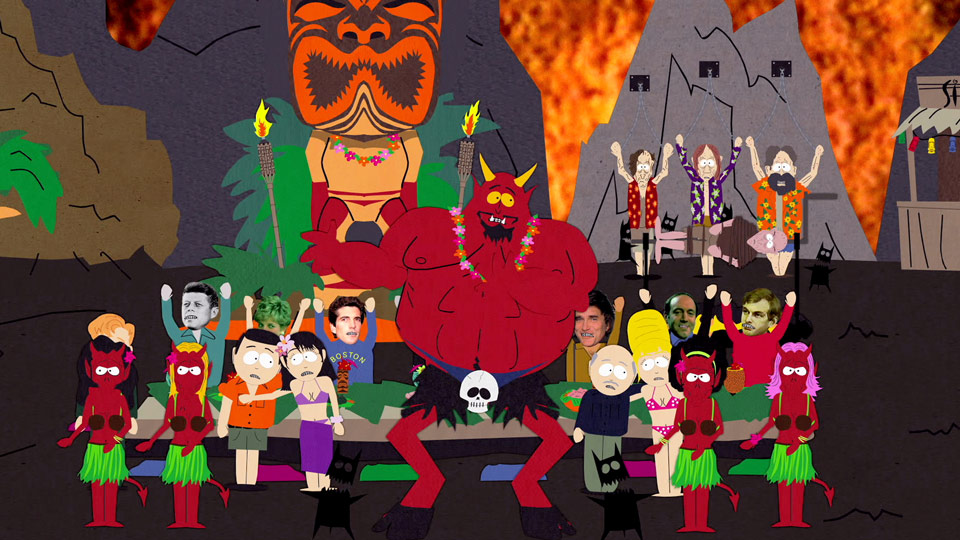
Meanwhile, in Hell, Satan is celebrating Luau Sunday with his friends, Conan O’Brien, Adolf Hitler, Jeffrey Dahmer, John F. Kennedy, John F. Kennedy Jr., Princess Diana Spencer, Michael Landon, Mao Tse-Tung, Gene Siskel, Allen Ginsberg, Jerry Garcia, Tiny Tim, Walter Matthau, Bob Hope, George Burns, Dean Martin and Frank Sinatra.
“Cartmanland,” the sixth episode of season five of South Park, contains a specific reference to the Book of Job. In the story, Cartman’s grandmother dies and leaves her entire life savings to Cartman, because she believes the rest of her family would just spend the money on crack. Cartman decides to use the money to fulfill his dream of having a theme park all to himself. So, he purchases a theme park that was on the verge of going out of business and renames it Cartmanland. Cartman uses the park solely for his own fun and makes it a point to advertise on television that no one else may enter the park or ride the rides.
Kyle is horrified that a person as despicable as Cartman is experiencing such good fortune and questions his faith in God. Kyle’s faith is further damaged by the discovery that he has a hemorrhoid. Kyle and Stan decide to try to break into the park by climbing the fence, but this only makes Kyle’s situation worse: his hemorrhoid breaks and becomes infected, leaving him hospitalized. Kyle’s parents try to cheer him up by reading him the Book of Job, but they forget to mention the ending, where Job receives more material wealth than he previously had. Kyle is horrified and his health begins to fade as the hemorrhoid infection spreads to his lungs.
Kyle’s health only improves when he discovers that Cartman’s plan to have Cartmanland all to himself fails and he ends up worse off than he was before inheriting the million dollars. Cartman had to allow in guests to defray operating expenses, was fined by the IRS for not keeping tax records, was sued by Kenny’s parents because Kenny died in the park, and ends the show by losing the park and being $13,000 in debt to the IRS, sprayed with mace and crying, restoring Kyle’s faith in God.
While there’s no indication that Jonah did any drinking while he was sitting in the belly of a whale for three days, the Biblical story has become tied up with the popular idea of swarthy sea dogs tipping back bottles of alcohol between rounds of pillaging and looting booty. Rum and pirates go together like Forrest and Jenny, so it isn’t surprising to find a brand of rum named “Jonah’s Curse.” In the Biblical story, Jonah wasn’t exactly cursed; he was punished by God for trying to flee to Tarshish instead of warning the Ninevites of their imminent destruction as he was commanded. That punishment involved sitting in the belly of a whale for three days until he repented.
The label of the bottle depicts a very large whale rising out of the water and towering over a ship with three masts. The whale could nearly swallow the ship in one gulp, which is a nod to the Biblical story. A whale would have to be very large for a person to live inside it for three days, after all. The rum is 47% alcohol per volume, so it is not for the faint-hearted, much like the task of walking into a major, populous city and announcing that God is going to smite them.
According to “Total Wine,” a sales website, the rum is “a rich, caramelized Caribbean run blended with 12 traditional spices. Vanilla, cinnamon and oaky notes on the nose – roasted pineapple, mangos and bananas on the palate.” The user “nezumitoo” on Instagram (also where I snagged the cropped portion of the above image) noted that Jonah’s Curse goes down smoother than The Kraken Black Spiced Rum and would be his first choice for any future purchases. The next time I pass by a liquor store, I will be stopping in to see if I can pick up a bottle myself.
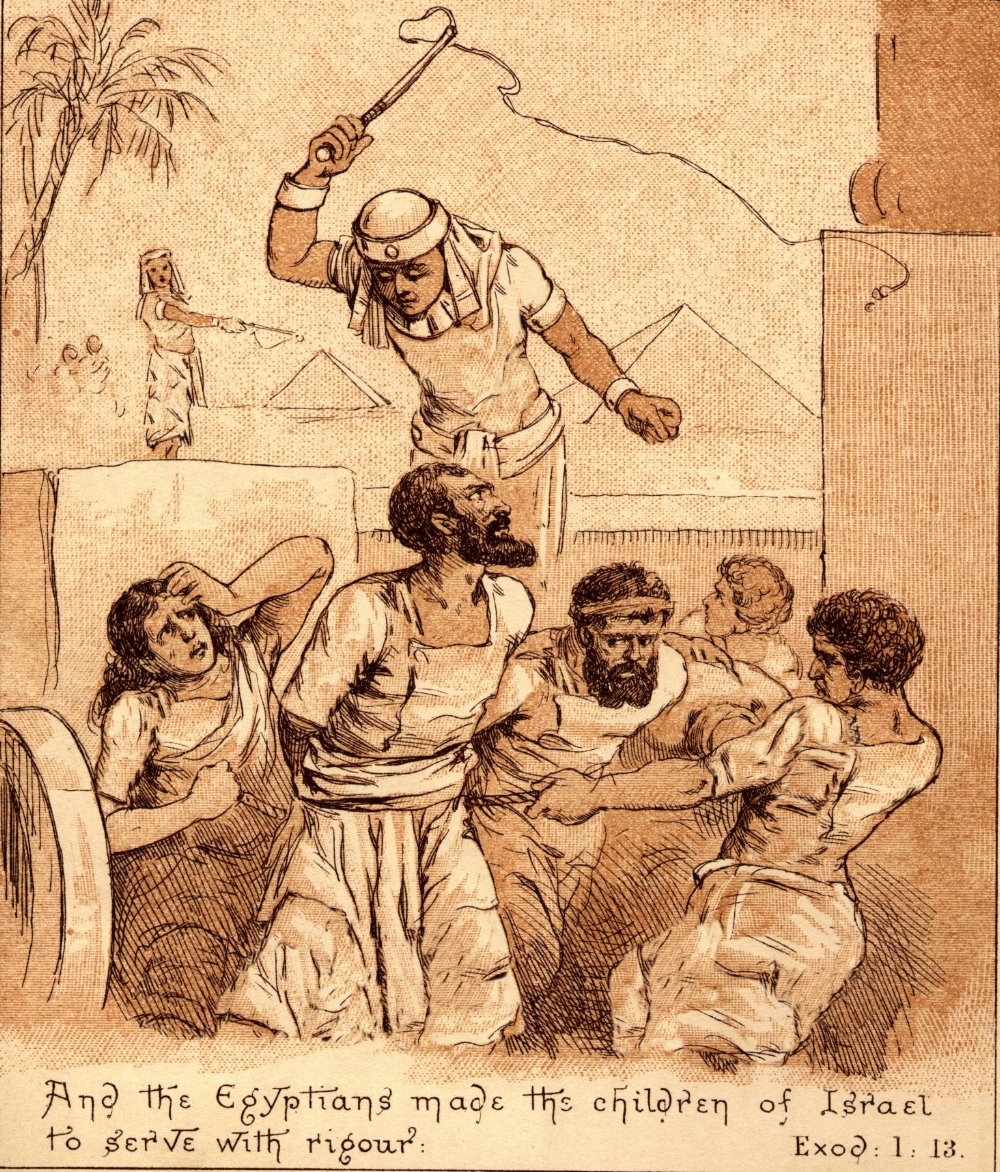
In the book of Exodus, the stories surrounding the Hebrews’ captivity in Egypt and their subsequent release after the Egyptians are afflicted by ten plagues from God creates problems theologically and philosophically. The stories raise questions about man’s free will and why man is held accountable for actions that he has no control over. In other words, if God makes a person commit a specific act, is that person responsible for that act, either good or bad? These questions have been addressed by many Jewish theologians and philosophers who, while not being able to definitively solve the perceived problem, have presented some possible solutions.
The way most philosophers seem to approach this topic is by focusing on whether or not Pharaoh had a choice when choosing to let the Israelites leave his territory. The phrase used in the text of Exodus says that at various times, God “hardens” Pharaoh’s heart after he suffers from a plague. While under the influence of that hardened heart, he considers Moses’ demand to let the Israelites go free and, of course, denies him (Frank, et al. 46-48). Having a “hardened heart” implies that Pharaoh’s free will was affected and he was not able to make a choice about whether or not to let the Israelites leave. Instead, the choice was made for him by God. Can Pharaoh be held accountable for his actions if he was not given a choice?
Maimonides looks at the broader story of the Hebrews becoming oppressed and enslaved by Egypt in order to understand why God hardened Pharaoh’s heart. He understands the question to be one of predeterminism and addresses whether or not Pharaoh had the free will to make a choice based on Abraham’s earlier conversation with God, in which God tells Abraham that Egypt will oppress Israel. Maimonides argues that man retains free will and that God does not preordain or compel disobedience (49). He clarifies this position by looking at proscriptions and punishments in the Torah. Just because a law and a punishment are listed does not mean that God has compelled a person who breaks the law to commit the sin. Instead, the man who breaks a law has free will, but God saw fit to inform us in advance of what the punishment would be for breaking a particular law.
Maimonides’ argument makes sense, but not for the situation he is trying to address. He is arguing that just because something is in the Torah, that does not mean it was directed specifically at any particular person, thereby compelling that particular person to act. However, the situation in question is indeed specific. God specifically stated that Egypt would oppress and enslave Israel. If one is to understand that God cannot contradict himself, then Egypt had no choice but to oppress Israel. It was preordained specifically by God (48-49). One could argue that the specific Egyptians who did the oppressing were not named and no specific date was given, but that is merely sidestepping the fact that at some point Egyptians would have to oppress Israel in order for God’s word to not be false. In other words, even if it had been another Pharaoh that chose to oppress Israel (if we’re assuming Pharaoh was able to make the choice), then it would be that Pharaoh in the story rather than the one currently being discussed. In order for God’s word to not be false, it would not be a question of whether something happened, but when it happened. Regardless of when Egypt oppressed Israel, we can reasonably believe that God would have followed through with the rest of the scenario he had already set in motion during that conversation with Abraham.
Another argument that Maimonides presents to justify God’s hardening of Pharaoh’s heart is to claim that Pharaoh essentially earned that punishment by deciding beforehand to “deal shrewdly” with Israel. God prevented Pharaoh from repenting in order to punish him for past wrongdoing (49). Is this really an argument that we want to want to make about God’s nature? Maimonides is essentially arguing that God will prevent a person from repenting if it suits his interests. That idea lacks the sense of justice that we attribute to God and that Maimonides himself recognized when he wrote that “…all of His ways are just” (50). It also denies man the free will to choose between good and evil that was, supposedly, obtained after consuming the fruit of the tree of knowledge of good and evil in Genesis 3 (9-10).
Another philosopher, David Shatz, acknowledges that in order for someone to be held accountable for an action, the action has to be performed when not impaired by an outside force. Shatz argues that free will is something that is valued in Judaism given the fact that the argument surrounding Pharaoh is brought up in the first place (51-52). Shatz states that even if we assume that free will is not as important an idea in Judaism as we would like to think, we are still left with three problems: responsibility, repentance-prevention, and the causation problem. Maimonides would say that Pharaoh was responsible because Pharaoh always had free will in the situation. Arguing that Pharaoh had free will would also solve the repentance-prevention problem, but Maimonides’ arguments on these points are unconvincing and ignore the problem of the hardening of Pharaoh’s heart. If Pharaoh was unable to choose, then why would he be responsible for his actions? If God hardened Pharaoh’s heart, then how can we know if Pharaoh would have changed his mind? Why would God prevent someone from repenting when Judaism teaches that God wants sinners to turn to him and repent?
The final problem, the causation problem, is one that Shatz does not address, but which is also the most interesting. The causation problem is the problem of God committing evil through Pharaoh. Can God commit evil? Shatz does not seem to think this question is relevant to his topic, but that is debatable because it addresses the question of responsibility that Shatz raises in his first problem. If Pharaoh is not responsible for the evil he commits, then who is? If God is in control, then does that not leave blame for the deaths caused by the plagues with God? Pharaoh was not the only one to suffer from having his heart hardened. The Egyptian people as a whole bore the brunt of God’s plagues. It is hard to believe that every Egyptian bore personal guilt or responsibility for Pharaoh’s actions.
The story seems to be framed in a way that assumes a people or tribe is one conceptual unit and bears collective responsibility for actions committed against other tribes or peoples. This could well be the case, considering the fact that later Arab tribes held this view, executing a blood debt on any member of the offending tribe, but this brings us back to the point of responsibility and accountability. If, in Jewish theology, people are responsible for repenting for their own sins, then why did God punish or kill Egyptians who were not directly responsible for Pharaoh’s choices? In addition to preventing Pharaoh from repenting and taking responsibility for his actions, God creates an evil act through Pharaoh and causes the deaths and suffering of many innocent people. So, even if one believes that a person has the free will to choose to do good, one is left with the impression that we might be left to suffer or die just so God can prove a point, and perhaps not even a point about a situation in which we are directly involved. Because our neighbor needs to learn a lesson, God may destroy us as well. Is that justice?
Shatz presents a few solutions that were proposed by Jewish philosophers in an attempt to overcome some of these obstacles. He states that some people have attempted to argue for a redefinition of “hardening.” Instead, one should understand the term to mean keeping someone alive or providing respite. Shatz notes that this tactic is rejected by most interpreters. The “modest” solution argues that even if God had not hardened Pharaoh’s heart, the plagues alone were coercive enough that had Pharaoh released Israel, it would not have been of his own volition so God did not change the outcome. Another claim is that by hardening Pharaoh’s heart, God actually made him immune to the coercion of the plagues, thereby allowing him to make a choice freely, based on his character. Yet another theory is that the hardening itself was a punishment, meaning that the loss of free will and Pharaoh’s inability to repent was his punishment for not repenting previously. The naturalistic approach supposes that when it is stated that God hardens Pharaoh’s heart, what is meant is that Pharaoh’s heart is reacting naturally due to his habitually bad choices.
In the solutions proposed above, there are still problems. If God’s influence in Egypt had no impact on the outcome, then why is God a part of the story at all? If God made Pharaoh impervious to the suffering of the plagues, what was the purpose of the plagues in the first place? If Pharaoh was unable to repent, again, what was the purpose of the plagues? And finally, if Pharaoh’s heart was hardened through a natural process and God knew Pharaoh would reject setting the Israelites free, why create a situation that knowingly leads to destruction? There must be a motive of some sort to follow through with this scenario. In the text of the story in Exodus, God says he is hardening Pharaoh’s heart in order to demonstrate his power before the Egyptians (46). Is that reasonable? Even if we assume that Pharaoh somehow deserved what happened, the plagues created devastation throughout Egypt, harming people that had nothing to do with Pharaoh’s decisions. Additionally, God’s stated motive implies that he seeks fame and is willing to both suspend free will and kill the innocent to obtain it. Besides anthropomorphizing God, the reason for the plagues stated in the Torah would mean that God victimized Pharaoh and the Egyptian people simply to show that he is the most powerful god in the region.
It is difficult to harmonize the idea that God would nearly destroy a whole people just to prove a point with our modern conception of what God is. However, this opens up the possibility of another solution to the problem of Pharaoh, free will, and accountability. Stories in the Bible often have some sort of moral or lesson to teach. Perhaps the story of Pharaoh was not about free will at all, but rather about God’s glory and power and his position as Israel’s protector. The use of Pharaoh as a framework for demonstrating that power may just be a literary device and, when the story of the Exodus was first told, it made perfect sense that the personal deity of a tribe would restrict or alter an enemy ruler’s ability to reason without that having implications for the Israelites because one’s enemies were not subject to the same deity. There is some indication that God’s actions were based on a tribal rather than universal scale in the sense that the Egyptians are seen as collectively responsible for the actions of their leader.
This does not, of course, solve the question of free will raised by the philosophers who have analyzed the story. In terms of whether man has free will or not, that is hard to say. I am inclined to say that if God takes any active role in history then man does not have free will, because, from the moment God influences events, later events have become predetermined as a result of those actions. Choices man might otherwise have made are influenced, or those choices never materialize and man is left with one course where there might have been two or more. Shatz argues that a man is not responsible for his actions if his free will has been affected. If that is the case, then I am inclined to say that there is no room for God to intervene in human affairs while still positioning man as responsible for his own actions.
Works Cited
Frank, Daniel H, Oliver Leaman and Charles H Manekin, The Jewish Philosophy Reader. New York: Routledge, 2004. Book.
Genesis 28:10-19 describes a dream experienced by one of the Jewish Patriarchs, Jacob. In the chapter 28 version of events, Jacob is hoping to obtain a wife from his mother’s family in Haran. After a day of traveling, he stops for the night in an undisclosed location and dreams that he sees a ladder reaching from Earth to Heaven, on which angels are both ascending and descending. Jacob believes that the place where he slept is “the house of God” and “the gate of heaven” (The New Oxford Annotated Bible, NRSV with Apocrypha, 4th ed., p. 50).
The idea of the ladder being a way to actually access Heaven utilized in episode 12 of season 6 of South Park (Nov., 2002), “A Ladder to Heaven.” In the cartoon, Stan, Kyle and Cartman win an all-you-can-grab candy prize. They give the ticket stub to Kenny for safekeeping but, as usual, Kenny is killed. In an effort to recover the ticket stub, Kenny’s friends decide to build a ladder to Heaven. Initially, the larger community sees the ladder as a tribute to Kenny’s memory, but the ladder quickly becomes an international competition when Japan decides to build their own ladder into Heaven first. The US Army becomes involved and the ladder passes above the clouds. Stan and his friends are disappointed that they couldn’t find Heaven (and the ticket stub) at the top of the ladder, but the military does discover suspicious-looking clouds that they believe might be a heavenly WMD factory being run by Saddam Hussein, who is deceased in the show. The U.S. government decides that the only option available to them is to preemptively bomb Heaven. The show later reveals that Saddam’s chocolate factory was indeed a WMD factory and he has been lying to God about what he manufactures there.






 Bradley's Old Fashioned Weblog