The following is a book review I had to write for a history course titled, “Traditional Civilizations of India.” The book is fictional, but deals with issues that helped to explain and give a starting point for research into the Vedic religion of India. Essentially, a very un-religious person dies in a very religious village, and no one knows quite what to do with him. The book focuses on the conflict between religious obligations and temptation and how to navigate between the two to do what’s right. In the end, it leads to a spiritual awakening for the main character, going out into the world and seeing first-hand how the people actually live, which is somewhat reminiscent of what happened to Siddhārtha Gautama, the Buddha. I have no idea what my grade was for this paper, because it was turned in on the last day of class, but my final grade for the course was an A+.
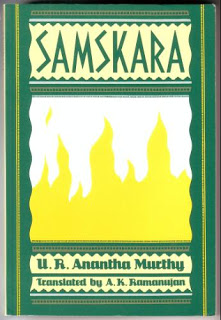
“Alive, Naranappa was an enemy; dead, a preventer of meals; as a corpse, a problem, a nuisance” (Murthy 3). The central issue of the book Samskara, by U. R. Anantha Murthy, revolves around the death of a Brahmin who broke all the rules and flaunted it. In Durvasapura, a village of supposedly orthodox Brahmin, Naranappa stood out as the exact opposite of everything a Brahmin should be. He was wild, partied, socialized and had sexual encounters with people outside of his caste, destroyed holy relics and ate sacred fish. In other words, he broke every taboo associated with being a Brahman. His behavior while alive seriously complicated the means of disposing of his body after death for all those around him. The fact that he died from plague and his corpse was a health hazard to the rest of the group seems to have gone completely unnoticed in this story. The focus, instead, is on the spiritual ramifications of dealing with Naranappa’s remains. Who is responsible for performing the rites, and should the rites be performed at all?
According to the leader of the Durvasapura Brahmin, Praneshacharya, the “Crest-Jewel of Vedic Learning,” a deceased Brahmin’s funeral rites should be performed by a relative or, in the absence of a relative, any Brahmin will do (Murthy 5-6). This would seem to solve the problem, since Naranappa has living relatives in the village. Unfortunately, he managed to alienate them all before dying. Naranappa and Garuda shared a common ancestor, but Garuda had quarreled with Naranappa’s father over ownership of an orchard. When Naranappa’s father died, Garuda attempted to gain possession of the orchard by receiving a ruling in his favor from a guru. Naranappa ignored the ruling and, according to Garuda, they swore they’d have nothing to do with each other for many generations after that. Lakshmana, Naranappa’s other relative, is married to the sister of Naranappa’s deceased wife. Lakshmana argues that Naranappa’s abandonment of the woman, and her subsequent insanity and death are things that he just cannot condone (Murthy 7). So, there are no relatives willing to perform the funeral rites. This causes the responsibility to shift to the Brahmin community as a whole.
Rather than create an easy opportunity to get Naranappa’s funeral rites done, this does nothing to solve the problem. Naranappa’s behavior has caused him to become polluted in the eyes of the Brahmin. Having anything to do with him would cause them to become polluted and lower their social and spiritual standing in society. According to Jonathan Haidt:
Hinduism very explicitly places all creatures onto a vertical dimension, running from the gods above, to the demons below. People rise and fall on this vertical dimension based on the degree to which they behave like gods or demons in this life. [1]
For high caste Hindus, proper behavior is regulated by The Laws of Manu. It tells them how to avoid becoming polluted and part of avoiding pollution is avoiding people who are lower on the vertical dimension, those who are impure. This is made evident at the very beginning of Samskara, when Praneshacharya mentally debates whether or not to answer the door for Chandri, since even speaking to her would pollute him and he’d have to wash again before dinner (Murthy 2). If speaking to someone from a lesser caste causes pollution, then certainly handling the dead body of a Brahmin who spit in the eye of Brahminism would be excessively polluting.
The Brahmin in Durvasapura are aware of the risks of pollution involved with performing funeral rites for Naranappa, and rather than take on that burden, they are intent on finding a way to avoid it, even at the cost of slightly tarnishing their Brahminism. Obviously, performing the funeral rites would be the greater evil, and the more polluting option. With that in mind, one of the Brahmin, Dasa, proposes that they ask the Bramin of Parijatapura to perform the funeral rites, on the grounds that they were friends with Naranappa and shared meals together (Murthy 12-13). This is important, because a person wouldn’t eat meals with someone that they consider polluting. Unfortunately for the Durvasapura Brahmin, the Parijatapura Brahmin understand the precariousness of their social standing and are unwilling to perform the rites. Praneshacharya says that “friendship is as strong a bond as blood,” but obviously the fear of pollution is the stronger force in society (Murthy 13).
With Naranappa’s body still lying unattended and no one volunteering to take responsibility for the funeral rites, the question of his status as a Brahmin is raised, perhaps in the hopes of pushing him off onto a lower caste. If Naranappa were declared to not be a Brahman, then it wouldn’t be required that a Brahmin perform his rites. Naranappa managed to break all the rules. He drank liquor, ate meat, socialized with Muslims, engaged in sexual relations with low caste women and destroyed sacred objects and animals. He completely threw out the concept of purity and pollution and even made remarks like, “If I were still a Brahmin…,” that indicate he clearly considered himself to be outside of the Brahmin caste (Murthy 23). But, was it enough to remove him from the caste system in the eyes of the greater Indian community? There is some social mobility in the caste system, in moving from one to the other, but is it possible to be removed from the Brahmin caste posthumously? According to Praneshacharya:
…he may have rejected brahminhood, but brahminhood never left him. No one ever excommunicated him officially. He didn’t die an outcaste; so he remains a brahmin in his death. Only another brahmin has any right to touch his body. (Murthy 9)
So, this brings things back around to the original problem. Naranappa died a Brahmin and must be given rites as a Brahmin, but because he’s extremely polluted, no one wants to perform them.
Despite the fact that Praneshacharya is a Crest-Jewel of Vedic Learning, he is unable to come to a conclusion regarding the disposal of Naranappa’s body, which is all the while rotting and literally polluting the entire agrahara with plague and a horrible stench. Without debating the reasons for Praneshacharya’s inability to make a decision, there are several options that were available to him, most of which he was aware of, and all of which he should have been aware of.
The first solution is one that is introduced at the beginning of the story, when the Brahmin first gather to discuss the funeral rites. Praneshacharya says:
Garuda said: an oath stands between him and Naranappa. Yet the Books of Law have ways of absolving such oaths—you can perform a rite of absolution, give away a cow, make a pilgrimage. But this is an expensive matter and I’ve no right to ask anyone to spend his money. (Murthy 9)
Immediately after saying this, Chandri offered up the gold that Naranappa had given her to pay for the expenses of the funeral rites. Why did Praneshacharya not state that the gold should be used to absolve the oath, as well as perform the rite? It would have remedied the situation immediately, and since the gold was freely given for that express purpose, then there was no harm in it, only inconvenience to Garuda. Would it have been polluting? Perhaps, but on the other hand, if Praneshacharya had given the advice, then Garuda could have rested easy in the knowledge that the best learned person in the community had told him it was right.
Another option available to Praneshacharya would have been to take the gold and perform the rites himself. As the head of the community, Praneshacharya is ultimately responsible for the well-being of all the agrahara’s inhabitants. To leave a rotting corpse lying unattended, spreading disease, while people bicker over fine points of doctrine is wholly irresponsible. Despite the pollution, he should have made the sacrifice for the greater good of the community. To balance out the pollution of performing the rites, he would have restored the normal flow of life in the agrahara, including the worship. Surely that counts as good. Additionally, he could have donated the rest of the gold to a temple.
Outside the context of the story, the translator indicates in the afterword that as a Crest-Jewel of Vedic Learning the answer to the problem should have been obvious to Praneshacharya. The translator says that the answer to the problem is found in a text called the Dharmasindhu. He says that “certain simple ritual modifications and offerings would have solved the problem, as the guru of Dharmasthala clearly suggests” (Murthy 145). In the story, Chandri’s gold made the funds that would likely be necessary for such ritual modifications available to Praneshacharya. Why didn’t he know about the Dharmasindhu? Well, the most likely answer is that Samskara wouldn’t have made for a very good story if he had known how to solve the problem before it began. Besides, the real conflict of Samskara isn’t so much about the inability to find a solution to performing the funeral rites for Naranappa as it is about a conflict between traditional religion and modern life, but that is not the topic of this essay.
In the sort of situation presented by the story, some amount of pollution was unavoidable. Praneshacharya should have realized this right from the start, and instead of trying to find a perfect way to solve the problem, he should instead have been looking for the least polluting solution. Resolving the problem would have saved the agrahara from the stench and complete disruption of their lives. It’s hard to believe that none of the villagers knew the danger of having a plague-killed corpse sitting in their village. Removing the body would have likely saved the lives of some of the brahmin as well. Taken together with providing the brahmin a way to resume their prayers, the pollution caused by performing the funeral rites would likely have been balanced out, whether the person that performed them was Praneshacharya or another brahmin.
[1] J. Haidt’s work is on a single web page. As such, no page numbers are available.
Works Cited
Haidt, Jonathan. “Elevation and the positive psychology of morality.” 10 May 2001. University of Virginia: Faculty. Web. 13 November 2011.
Murthy, U.R. Anantha. Samskara: A Rite for a Dead Man. New York City: Oxford University Press, 1979. Print.


























 Bradley's Old Fashioned Weblog