20 April 2012

Unity, Support and Power: Failure of Palestinian Nationhood

Note: This is a paper that was written for a Modern Middle East undergraduate history course.  The paper was supposed to be five pages long, but I went a little overboard.  Even so, I don't think I even came close to fully covering the topic, not that I really could in a semester, or in one short research paper.  Nonetheless, this paper received an A.

At the end of World War I, with the fall of the Ottoman Empire, the entire Middle East was in a state of flux. What used to be a single sovereign entity was carved up into modern nation states by the victorious European powers. At a conference in San Remo in 1920 Britain and France, according to an arrangement known as the Sykes-Picot Agreement (1916), drew the borders for four new states: Iraq, Syria, Lebanon and Palestine. In 1922, Palestine was further divided into Palestine and Transjordan. These new countries were legitimized as mandates of the League of Nations, states that would be protectorates of European powers and eventually gain independence. Thus, Britain retained control of Iraq, Palestine and Transjordan and France retained control of Syria and Lebanon, directly and indirectly.[1]

Over the following decades, each of the mandate states threw off the shackles of colonialism and won independence, with the exception of Palestine. The pursuit of national independence for Palestinians has been impeded by a series of complications, starting with the Balfour Declaration of 1917:

His Majesty’s Government [of England] view with favour the establishment in Palestine of a national home for the Jewish people, and will use their best endeavours to facilitate the achievement of this object, it being clearly understood that nothing shall be done which may prejudice the civil and religious rights of existing non-Jewish communities in Palestine, or the rights and political status enjoyed by Jews in any other country.[2]

The Balfour Declaration is a letter that was issued by the United Kingdom’s Foreign Secretary, Arthur James Balfour, to Baron Rothschild, a leader of the British Jewish community. British government officials believed that the Jewish ‘vote’ needed to be won to ensure victory in World War I. If the British didn’t secure Jewish backing, the Germans would “buy them” and use them to influence Russia into signing a separate peace treaty with Germany, allowing the Germans to focus on the western front.[3] The Balfour Declaration was a response both to the fear of the supposed power of world Jewry and the sympathetic nature of some British government officials to the Zionist cause.[4] Zionist leaders did their best to encourage these feelings, resulting in the inclusion of the wording of the Balfour Declaration in the League of Nations sanctioned British mandate for Palestine in 1922.[5]

Contrary to the popular idea that Palestine was a land without a people for a people without a land, the area was well populated. At the beginning of the Zionist influx into the Palestine Mandate area, there were approximately 450,000 Arab and 20,000 (Arab) Jewish residents.[6] Direct British rule and British efforts to fulfill the obligations of the Balfour declaration combined with the influx of European Jews created a volatile situation that retarded the national development of Palestine. Instead of developing modern governing institutions like other newly formed Middle Eastern nations, Palestine’s residents spent the mandate period in conflict and constant competition between British, Jewish and Arab interests.

The major conflict between the two groups was based on the meaning of the Balfour Declaration. The Zionist interpretation of the Balfour Declaration was that it intended the creation of a Jewish state that, as Chaim Weizmann (Chair of the Zionist Commission and later first president of Israel) said, would be as Jewish as England is English.[7] Critics of the Zionists interpreted the Balfour Declaration’s goal as the creation of a Jewish cultural center inside an independent Arab state. The ambiguity was introduced into the document to give the British room for diplomatic maneuvering, but in the end, all it did was complicate their position in Palestine. They were never able to resolve the contradiction inherent in their promise.[8]

The confusion in policy created by the Balfour Declaration led one senior British official to say, just prior to leaving the country, that Britain had “nothing but fluctuations of policy, hesitations…no policy at all.”[9] The British alternately supported Jewish development of a national home and Arab national aspirations in a precarious balancing act intended to maintain the status quo. This remained true until their withdrawal from Palestine in 1948, twenty five years later. When the last British High Commissioner departed Haifa, there was no formal transfer of powers to a new local government because there was no government in Palestine. When the mandate ended, the Jews and Arabs were left to struggle for supremacy.[10]

The internal struggle for power in the years and months leading up to the end of the British mandate for Palestine and the subsequent war that started on May 15th, 1948 with the end of British mandatory rule between Jewish and Arab irregular forces from the surrounding nations saw the birth of the state of Israel and the failure of the Palestinians to establish a nation. The reason for the success of the Jews over the Arabs boils down to three key differences: unity, external support and military power. The Jews entered Palestine with a unified goal, if not a unified ideology. They enjoyed wide support from Jewish and Christian communities around the world, as well as the backing from Britain guaranteed by the Balfour Declaration. They also took advantage of their ties to Europe to advance their military prowess, which proved decisive in the 1947-1948 conflict with the Arabs, also known as the first Arab-Israeli War. The Palestinian Arabs, on the other hand, were completely unprepared for the task ahead of them.

During the early years of the mandate, the Arab notables felt it was only natural that they should govern the land they had lived on for centuries.[11] They were convinced that at some point the British would come to their senses and stop supporting the Jews. In the meantime, the Arab notables in Palestine did what they could to maintain their social status, including working with the British mandate authorities, who supplied them with positions of authority.[12] For example, the British created the office of Grand Mufti of Jerusalem and assigned al-Hajj Amin al-Husayni to the role. Later the British created the Supreme Muslim council, which Husayni headed.

The reliance of Arab leadership on the British caused them to mostly work with, rather than against, the mandate government, which also meant that they were indirectly supporting the Zionist occupation of what they considered to be Arab land. The Arab notables attempted to negotiate with the British privately while condemning British support of Zionism publicly, all the while working to ensure there would be no disruptive mass political demonstrations that could destabilize their social and political positions.[13] The need to stay on good terms with the British undermined the authority of the Arab notables in the eyes of the public.[14] Further complicating the Arab political atmosphere in Palestine was the constant rivalry between the two prominent families in the region: the Husaynis and the Nashashibis. Their attempts to create rival power bases in Palestine prevented Arab unity. The inter-Arab rivalries and reliance on the British, together with the need to suppress popular movements to maintain their positions, caused the Palestinians to never be capable of forming a unified front, which effectively neutered the Palestinian political body and Palestinian aspirations of nationhood. It would be fair to say that the goals of the Arab leadership (to maintain their positions) did not match the goals of the Palestinians, but due to the Ottoman top-down power structure, the average Palestinian had no way to directly influence the decision making process until later in the mandatory period, when guerilla leaders like al-Qassim began to rally popular support.

Compounding the problem was the lack of any meaningful external support for the Palestinian Arabs. To start with, none of the Arab political institutions formed in mandate Palestine were recognized by any international authority, not even by the Arab states, who took it upon themselves to speak for the Palestinian Arabs.[15] But, their motives weren’t entirely pure either. Throughout the mandate period, the surrounding Arab states had, despite repeated requests, failed to supply the Palestinian Arabs with arms, food, or any financial support. The Arab states each had different agendas in terms of what they wanted to accomplish in Palestine, but the rights of the Palestinians themselves probably ranked very low on their list of priorities. Most of the surrounding states were solely interested in land grabs to increase the power of their respective states in terms of inter-Arab regional politics.[16]

By the time hostilities broke out in Palestine after the November 1947 announcement of the UN Partition Plan, the Arabs felt a distinct sense of abandonment. They had no effective leadership and they had been isolated by the surrounding Arab states. According to Rashid Khalidi,

The Palestinians entered the fighting which followed the passage of the UN Partition Resolution with a deeply divided leadership, exceedingly limited finances, no centrally organized military forces or centralized administrative organs, and no reliable allies.[17]

According to a Haganah Intelligence Service – Arab Division executive, the average Palestinian had come to the conclusion that they could not hold their own against the Jews.[18] HIS – AD further reported that most of the Arab public would be willing to accept the 1947 UN Partition Plan and lacked a desire to engage in a war with the Jews because of a lack of weapons and internal organization.[19] Many were unwilling to fight because if they died, there would be no compensation for their widows and/or orphans.[20] In many cases, the roving militia bands from the surrounding Arab countries intimidated and exploited the local population, further lowering morale.[21] Because the surrounding states refused to fund or arm the Palestinians, they were forced to rely on external militias which often preyed on them and reduced their own ability to resist Jewish military forces. In addition, due to disorganization and a lack of communication with forces from other Arab states, they were ineffective against the highly organized Jewish Haganah.

The Zionists, in contrast, presented a much more unified front. There were differences of opinion over specifics, but the overall goal was clear: creation of a national home for Jews and, as anti-Jewish violence escalated, self-preservation. The Jews had multiple advantages over the Palestinians. The Balfour Declaration, which so hindered the Palestinians’ political efforts, was a boon to the Jews. It’s inclusion in the League of Nations mandate for Palestine immediately gave the Jews international recognition, elevating the Jewish Agency offices around the world to the status of virtual embassies for an as yet uncreated state.[22]

The Palestinian Arabs couldn’t actively cooperate with the British mandate government because to do so would legitimize the mandate, which established the Jewish homeland in Palestine. The Jews had no such restrictions. Because of close cooperation with the British, the Jews were able to build para-government institutions that rivaled those of recognized states before the mandate period ended. They developed labor unions, a democratically elected political body, political parties, education systems and, most importantly, a well-trained and organized military.[23] They worked closely with the British to develop Jewish defense forces during the Palestinian Arab revolts in 1936-1939 and some Jews had served in British units during World War I and World War II.[24] Additionally, the Jews had access to external finances from world Jewry, especially American Jews.[25]

The Jewish objective was the fulfillment of a two thousand year old dream: the creation of a Jewish state to replace the one they lost to the Romans. The Arab objective was to prevent it from happening and create an Arab Palestinian state. There was no middle ground between these two positions. Two states cannot exist in the same territory. The conundrum the British created for themselves prevented them from moving in one solid direction and assisting in the foundation of a new state in Palestine. The struggle was left to the two parties involved, with open hostilities breaking out between Jews and Palestinian Arabs in 1947 and escalating into a conflict between the newly established Israeli state and the surrounding Arab states in 1948. In that struggle, the Palestinians failed to succeed in achieving nationhood due to a lack of unity in their leadership, the failure to develop a capable military, and because of the clear advantage the Jews had in support from external states and communities.


[1] Ira M. Lapidus, A History of Islamic Societies, p.539.
[2] David W. Lesch, The Arab-Israeli Conflict, p. 85.
[3] Tom Segev, One Palestine, Complete, p. 38.
[4] Ibid., p. 5 & p. 33.
[5] David W. Lesch, The Arab-Israeli Conflict, p. 95.
[6] Benny Morris, The Birth of the Palestinian Refugee Problem Revisited, p. 40.
[7] David W. Lesch, The Arab Israeli Conflict, p. 95.
[8] Ibid.
[9] Tom Segev, One Palestine, Complete, p. 9.
[10] David W. Lesch, The Arab Israeli Conflict, pp. 138-139.
[11] Rashid Khalidi, The Iron Cage, p. 80.
[12] David W. Lesch, The Arab Israeli Conflict, p. 97.
[13] Rashid Khalidi, The Iron Cage, p. 78.
[14] Ibid., pp. 77-78.
[15] Rashid Khalidi, The Iron Cage, p. 167 & David W. Lesch, The Arab-Israeli Conflict, p. 136.
[16] Benny Morris, The Birth of the Palestinian Refugee Problem Revisited, pp. 34-35.
[17] David W. Lesch, The Arab-Israeli Conflict, p. 135-136.
[18] Benny Morris, The Birth of the Palestinian Refugee Problem Revisited, p. 86.
[19] Ibid., p. 87.
[20] Ibid., p. 112.
[21] Ibid., p. 114.
[22] David W. Lesch, The Arab-Israeli Conflict, pp. 166-167.
[23] Ira M. Lapidus, A History of Islamic Societies, p. 557.
[24] Tom Segev, One Palestine, Complete, p. 430, p. 452 & David W. Lesch, The Arab-Israeli Conflict, p. 99.
[25] Benny Morris, Birth of the Palestinian Refugee Problem Revisited, p. 34.


Works Cited

Khalidi, Rashid. The Iron Cage: The Story of the Palestinian Struggle for Statehood. New York: Beacon Press, 2007. Kindle edition.
Lapidus, Ira M. A History of Islamic Societies. 2nd. New York: Cambridge University Press, 2002.
Lesch, David W. The Arab-Israeli Conflict: A History. New York: Oxford University Press, 2008. Print.
Morris, Benny. The Birth of the Palestinian Refugee Problem Revisited. New York: Cambridge University Press, 2004. Print.
Segev, Tom. One Palestine, Complete: Jews and Arabs Under the British Mandate. New York: Henry Holt and Company, LLC, 2001. Print.


02 April 2012

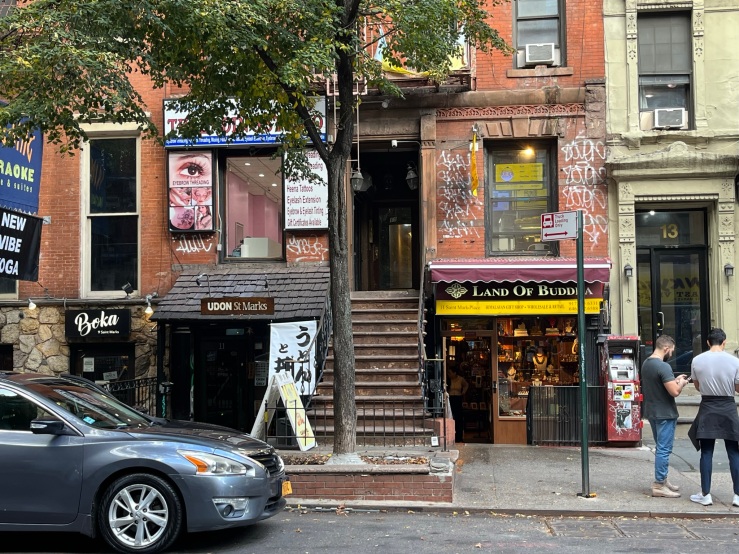
Boka Bon Chon & Wafels and dinges


I just can't get enough of those damn fried chicken wings and drumsticks!  I don't know how they make them, but they come out so crispy and delicious that I don't mind that the spicy ones are burning my face off.  I just keep eating them!  They also come in soy & garlic flavor, which is great.

I've been gradually getting my wife around to all of the places I want to show her here in NYC that I already know about and Boka Bon Chon finally came up on the list.  We were in the mood for something Asian and we were in the neighborhood, so we went on in.


Besides the wings, which are an absolute must if you ever go to this place, we got the kimchi bi bim bob and an order of beef bul go gi.  The servings are generous.  Maybe we were hungry, or it was just particularly good yesterday but we cleaned our plates and stripped the bones.


Then we saw a food truck.  A bright yellow food truck with a delicious scent coming from it.  It turned out to be "Wafels and dinges," which sells different types of waffles with a variety of toppings, including one called a "WMD" and, gross as it sounds to me, waffles with bacon or pulled pork.


We were feeling the food we'd just eaten, so we got one and shared it.  It was incredibly good!  I'm looking forward to the next excuse we can find to eat at this food truck again.  =)

For a Sunday afternoon, this was a great meal.  I love NYC.

29 March 2012

Occupy Union Square?

Yesterday I went to Petco at Union Square to pick up two 20 pound boxes of cat litter while they were on sale.  Carrying that cat litter was a pain in the ass because I couldn't get a cab and had to take the bus, but that's another story.

On the way to Petco, I noticed a lot of people standing around the 14th street side of Union Square with signs.  I'm not surprised.  It seems like there's a protest there at least once a month or more.  There was a protest there over the Trayvon Martin incident, for example.


I can only assume this group is protesting police brutality, but I didn't stop to ask for specifics.  There was something about the way most of the people looked, the way they carried themselves, that screamed low class and potentially dangerous.  One guy looked homeless and the girl in the purple tube top (just to the right of the pink tree on the left of the photo) kept pulling her top up and down, like she was moments from stripping naked to add flavor to the protest.  I wondered if they were drunk or on drugs.  I know it's not good to just throw a judgment out there based on how people look, but on the other hand, if you want to be taken seriously, you should look serious.


The group of people protesting wasn't actually that large.  It's hard to tell from the photos where the protesters end and the normal Union Square crowd begins, but they mostly seemed to be huddled into one corner near that pagoda subway entrance.


There were police hanging around and I had things to do so I just minded my own business and kept going.  The reason I wonder if these people are trying to 'occupy' Union Square is because I saw them there again today, including the guy that looks homeless.  He had a ruck sack with what looked like a yoga mat.  Maybe he slept on it?  Also, a few of them seemed to have luggage with them (right side in above photo).  The police were still there today too.